Back pain is one of the most common health complaints in Australia, and if you are living with it, you are certainly not alone.
According to the Australian Institute of Health and Welfare (AIHW), around 4.0 million Australians, or approximately 16% of the population, were living with back problems in 2022.
In fact, back pain and problems were identified as the leading cause of non-fatal disease burden in Australia in 2024, making it a significant public health concern that deserves serious attention.
With so many people searching for long-term solutions beyond medication or passive treatments, Pilates has emerged as one of the most widely recommended exercise approaches for back pain management.
But is it actually good for back pain? And what does the clinical evidence say?
This article explores the relationship between Pilates and back pain, how it works physiologically, what the research supports, and what to consider before starting a program.
If you are exploring clinical exercise and pilates in Rosanna, contact our team at Excel Body & Health today.
What is Pilates?
Pilates is a form of low-impact exercise that focuses on controlled movement, breath, alignment, and the activation of deep stabilising muscles, particularly those of the trunk, pelvis, and spine.
There are two primary formats:
Mat Pilates involves floor-based exercises using body weight as resistance, making it accessible and low-cost.
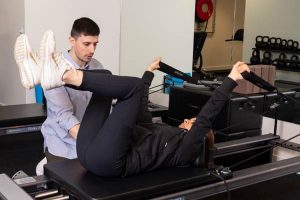
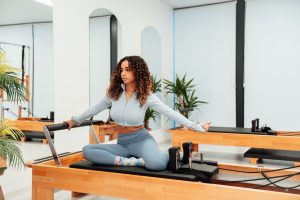
Equipment-Based (Reformer) Pilates uses apparatus such as the Reformer, Cadillac, and Wunda Chair. These provide adjustable spring resistance to support, challenge, and isolate movement patterns in a way that is often more appropriate for individuals managing pain or injury.
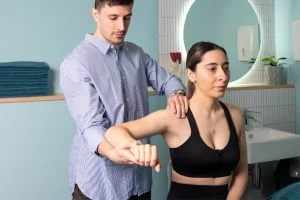
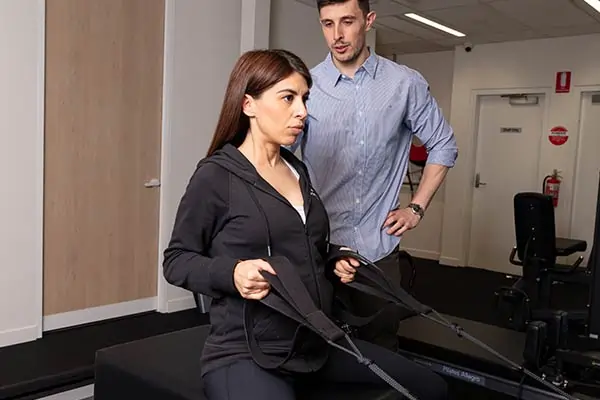
In a clinical context, Pilates is delivered or supervised by trained allied health professionals, most commonly physiotherapists, who tailor exercise selection and progression to an individual’s specific presentation and goals.
Why Does Back Pain Occur?
To understand how Pilates may help, it is useful to understand why back pain develops in the first place.
Lower back pain is not a single diagnosis but rather an umbrella term that encompasses a range of conditions. These include muscle and ligament strains, disc bulges or herniations, degenerative disc disease, facet joint dysfunction, spinal stenosis, and non-specific lower back pain, which accounts for the vast majority of presentations.
In many cases, persistent or recurrent lower back pain is associated with:
- Impaired activation and endurance of deep spinal stabilisers (such as the multifidus and transversus abdominis)
- Altered movement patterns and postural habits developed to protect or avoid pain
- Reduced spinal flexibility and hip mobility
- Decreased overall physical conditioning
- Heightened pain sensitivity over time
These factors are precisely what a well-structured Pilates program is designed to address.
What Does the Evidence Say About Pilates for Back Pain?
The body of research supporting Pilates as an intervention for back pain has grown substantially over the past decade. Several high-quality systematic reviews and meta-analyses have examined its effectiveness, and the findings are broadly encouraging.
A major systematic review and meta-analysis published in Disability and Rehabilitation found that Pilates can decrease lower back pain compared to no exercise and non-specific exercise, with researchers concluding that general practitioners should consider Pilates as an effective strategy to manage lower back pain.
A network meta-analysis published in the Journal of Orthopaedic and Sports Physical Therapy, which compared multiple exercise types for chronic low back pain, found that Pilates had the highest probability of being the most effective intervention for reducing pain among all exercise categories examined, including aerobic exercise, strength training, stretching, and McKenzie-based approaches.
A further systematic review focused specifically on core muscle activation found emerging evidence that Pilates positively impacts core muscle strength and can be an effective intervention for people living with chronic low back pain. Importantly, the review noted that Pilates was not inferior to equivalently dosed exercise programs, and was superior to no exercise or lower-dose alternatives when it came to core muscle thickness and stability outcomes.
It is important to note that while the overall trend in the literature is positive, many studies involve a moderate to high risk of bias and relatively small participant numbers.
This means results should be interpreted alongside clinical judgement rather than in isolation. Always seek assessment and advice from a qualified health professional before commencing any exercise program for back pain.
How May Pilates Help With Back Pain?
The mechanisms by which Pilates is thought to reduce back pain are well supported by exercise physiology and clinical observation.
1. Strengthening Deep Stabilising Muscles
The deep core muscles, including the transversus abdominis, multifidus, pelvic floor, and diaphragm, form an internal stabilising system for the lumbar spine. In many individuals with lower back pain, these muscles demonstrate altered activation patterns, firing too late, too weakly, or inconsistently in response to movement.
Pilates exercises are specifically designed to target this deep muscle system, often in a graded and progressive manner that avoids provoking pain.
2. Improving Spinal Mobility and Flexibility
Chronic tightness in the hip flexors, thoracic spine, and hamstrings can place excessive load on the lumbar spine, contributing to pain and dysfunction.
Pilates incorporates controlled movements that address these restrictions, gradually improving mobility while maintaining spinal alignment.
3. Promoting Neuromuscular Coordination
Pain often disrupts the normal neuromuscular patterns of movement. Pilates emphasises slow, deliberate movement with attentional focus on form, which may help retrain the nervous system and rebuild pain-free movement habits.
4. Reducing Fear of Movement
One of the barriers to recovery for many people with back pain is kinesiophobia, a fear of movement or physical activity due to concern about causing harm. The supported, progressive and professionally supervised nature of clinical Pilates may help rebuild confidence in movement, which is a critical component of long-term recovery.
5. Improving Posture and Load Distribution
Many Pilates exercises address postural alignment and teach individuals how to move in ways that distribute mechanical load more evenly across the spine and pelvis. Over time, this may reduce the repetitive strain on specific structures that contribute to pain.
Who May Benefit From Pilates for Back Pain?
Pilates has been studied in populations with a range of back pain presentations, including:
- Acute and subacute lower back pain
- Chronic non-specific lower back pain
- Disc-related conditions
- Post-surgical rehabilitation (where clinically appropriate)
- Pregnancy-related back pain
- Age-related spinal changes
It is generally considered a safe form of exercise for most adults when appropriately prescribed and supervised.
However, some presentations may require modification or a period of medical management before commencing exercise, such as severe nerve compression, fracture, or unstable spinal conditions.
This is why a thorough clinical assessment prior to starting is strongly recommended.
Starting Pilates for Back Pain
For many people living with lower back pain, a well-structured and clinically supervised Pilates program may be a low-risk and empowering intervention that addresses the root causes of their pain rather than simply managing symptoms.
As with any form of exercise therapy, individual response will vary, and Pilates should be considered as one component of a broader, evidence-informed management plan tailored to your specific needs.
Ready to Get Started? Talk to the Team at Excel Body & Health
At Excel Body & Health, our clinicians combine physiotherapy experience with clinical Pilates to deliver individualised programs designed around your specific condition, goals, and lifestyle.
Whether you are managing a recent flare-up or have been dealing with back pain for years, we take the time to understand your history and build a program that works for you, not a generic one-size-fits-all approach.
Contact Excel Body & Health today to book an initial assessment and find out whether clinical Pilates may be the right fit for your back pain.